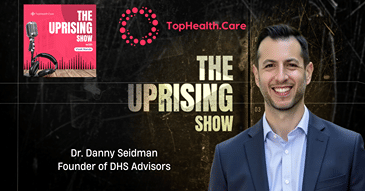
Welcome to The Uprising Show, where we explore bold ideas shaping the future of healthcare. In this episode, host Vivek Nanda sits down with Dr. Danny Seidman, founder of DHS Advisors and former primary care physician, who shares his journey from practicing medicine in the clinic to tackling systemic issues as an advisor. Dr. Seidman discusses the disconnect between what employers buy and what patients truly need, the power of price and claims transparency, and the myths employers believe about doctors. Tune in for insights on why involving clinicians in plan design matters, how direct contracting is changing the game, and the real reasons the status quo is so hard to disrupt.
Timestamps:
00:00 Scalable healthcare problem-solving
05:09 Discussing claims transparency
07:27 Involving the CFO in healthcare costs
11:05 Balancing clinical practice and demand
Insights from Dr. Danny Seidman: Bridging Clinical Practice and Benefits Advisory
Healthcare benefits are a critical aspect of the employee experience, yet the disconnect between what employers purchase and what employees truly need remains a persistent challenge. In a recent conversation, Dr. Danny Seidman, founder of DHS Advisors, sat down with Vivek to discuss his unique journey from clinic physician to benefits advisor and share valuable insights into how organizations can improve healthcare outcomes for their people. This episode is packed with actionable advice and myth-busting revelations that benefit executives, HR professionals, and anyone interested in the state of employer healthcare.
From Clinic to Advisory: Why Make the Switch
When asked about his decision to transition from clinical practice to the advisory side, Dr. Danny Seidman explained that his experiences in the clinic highlighted how problem-solving for individual patients could be scaled for greater impact. He emphasized that while clinicians are adept at diagnosing and treating patients one at a time, addressing systemic issues at the employer level can improve healthcare outcomes for thousands, making a broader positive difference in the workforce.
The Status Quo: Harder to Disrupt Than Expected
A key realization for Dr. Seidman was the entrenched nature of the status quo. He noted that simply showing decision-makers the benefits of higher quality or more affordable solutions is often not enough to create change. The power of established routines and reluctance to deviate from “how things are done” represent significant barriers to innovation within employer-sponsored health plans.
The Disconnect Between Health Insurance and Healthcare
One of Dr. Seidman’s central arguments is that employers often confuse "health coverage" or "health insurance" with "healthcare." According to him, employers typically purchase insurance products or point solutions that provide coverage, but what employees truly need is accessible, high-quality healthcare. Using these terms interchangeably can lead to confusion and missed opportunities to address employees’ real health needs effectively.
Why Benefits Teams Hold the Key
In discussing who can best solve common healthcare bottlenecks, Dr. Danny Seidman asserted that benefits teams are uniquely positioned to bring about significant positive changes. With the right approach and access to actionable data, benefits professionals can address issues such as high copays, financial barriers, and fragmented care delivery that individual clinicians cannot solve on their own.
Data Transparency: The Power Employers Don’t Realize They Have
A recurring theme was the importance of claims and price transparency. Dr. Seidman pointed out that many employers, particularly those who are self-insured, have both the right and responsibility to access detailed claims data. When plan sponsors review and analyze this data critically, they can spot inefficiencies, reduce waste, and ultimately design plans that better support employee health and lower costs.
Direct Contracting: A Working Model That Brings Hope
One solution Dr. Seidman sees yielding positive results is direct contracting between employers and clinical partners. This approach simplifies costs, increases transparency, and allows for a clearer measurement of investment return. It bypasses some of the complications inherent in traditional insurance relationships, making it easier to ensure quality care while controlling expenses.
Involving Financial and Clinical Expertise in Benefits Decisions
A major challenge for many organizations is that health plan decisions are often made by people without deep financial or clinical expertise. Dr. Danny Seidman recommends involving both CFOs and medical advisors to improve the quality of plan design decisions. He advocates for having at least a fractional medical advisor on board to ensure clinical considerations are reflected in plan offerings, helping prevent unintended negative outcomes while supporting smarter, people-focused policies.
Debunking Myths: What Employers Believe About Doctors
Dr. Seidman addressed several misconceptions, including the belief that doctors are both expensive and part of the healthcare cost problem. He clarified that only a tiny fraction of healthcare spending directly compensates physicians and that most doctors are eager to drive value and quality for patients, not just increase costs.
Looking Ahead: The Need for Continued Evolution
While Dr. Seidman continues to maintain clinical practice, he sees growing demand for healthcare advisory services that help employers make smarter, collaborative decisions. His goal is to keep influencing healthcare for the better, creating sustainable models that benefit both employees and their organizations.
The Uprising Show Website: https://theuprisingshow.com/
Vivek Nanda's LinkedIn: https://www.linkedin.com/in/viveknanda1/
Vivek Nanda's Twitter: https://x.com/vickks
TopHealth Media Website: https://tophealth.care/
“Disclaimer: Informational only. Not medical advice. Consult your doctor for guidance.”
[00:00:00] [SPEAKER_00] Let's talk about the disconnect between what employers buy, or at least they think, is healthcare, and what patients need.
[00:00:07] [SPEAKER_01] I think that employers purchase point solutions, they purchase health insurance, they purchase health coverage, and patients need healthcare. But with that comes a lot of waste, a lot of fraud, a lot of confusion about where is the best place to go in terms of cost and quality. What we need as a system is already there. We just need better ways to pay for it and better ways to guide patients towards it.
[00:00:30] [SPEAKER_00] In one sentence, your full name, title, and organization, and then we go into the questions.
[00:00:35] [SPEAKER_01] You bet. So again, nice to see you. Thanks for having me. My name is Danny Seidman. I'm founder of DHS Advisors.
[00:00:42] [SPEAKER_00] I guess my first question is always with your little bit time I spent with you, you are a physician who stepped onto the advisory side. So what made you want to, I guess, fix the system and not just work inside the system?
[00:00:56] [SPEAKER_01] Yeah. So directly my experience in the clinic, seeing a patient and, you know, part of what we do is diagnosis and treatment. A big part of what we do in primary care is problem solving. You know, we've already figured out the issue, but hey, how do I get this thing? How do I find this resource? Solving that for every individual over and over again. You know, we can do it, but it becomes a bit tedious for both the patient and the doctor.
[00:01:19] [SPEAKER_01] And when you realize that you can solve this on the scale for an employer, for example, all of a sudden you can make a positive impact on 5,000, 10,000 people instead of one by one.
[00:01:30] [SPEAKER_00] And when did you actually, how long this has been when you made this transition?
[00:01:35] [SPEAKER_01] It's happened slowly over time, but officially about 18 months ago.
[00:01:38] [SPEAKER_00] Oh, so you're really fresh into this world.
[00:01:40] [SPEAKER_01] Pretty fresh. Yeah.
[00:01:41] [SPEAKER_00] So I guess what's the observation you had where you felt like, oh, I thought this would be different, but it isn't even on this side?
[00:01:50] [SPEAKER_01] Ooh, that's a good question. I think, you know, the biggest assumption I made is that when I show everybody how things work, there's going to be outrage. There's going to be change. But the status quo is very powerful. And you'd be surprised it doesn't matter if you show people that things are higher quality or cheaper. It is very challenging to disrupt the status quo.
[00:02:10] [SPEAKER_00] Yeah. And I guess what does that show you that pure clinicians or pure benefits folks miss?
[00:02:21] [SPEAKER_01] Yeah, I think, you know, everybody's doing their best. I truly believe that. I think clinicians are heads down, seeing the patient that's in front of them. All the benefits folks I know are working really hard to make decisions that will be in the best interest of the people that they serve. But one example I always come back to is, you know, I was in the clinic and I had a patient there for emergency room follow up. OK, what happened? Well, I ran out of my medicine. Why?
[00:02:43] [SPEAKER_01] You know, we have the pharmacy is right here. And they said, well, I ran out on Monday. I get paid on Friday. I couldn't afford the $20 copay. And so $20 copay, you know, is not low, but it's not terribly high in these days in 2026. This is a person who is employed, intelligent. But the financial barrier was there. So despite good intentions, keeping copays relatively reasonable, having the pharmacy accessible.
[00:03:09] [SPEAKER_01] And, you know, personally, this is a problem I could solve just by purchasing the medicine and having it in the clinic. The medicine costs pennies. So a very easily solvable problem, except that the clinician, the employer and the patient were not all on the same page. But when we are, amazing things can happen.
[00:03:24] [SPEAKER_00] And do you think, like, it's really the benefits problem, this to the core? Because at the end, if everybody knows their role more effectively, I think better solutions can be formed, right? So what would you name this problem, I guess?
[00:03:40] [SPEAKER_01] Yeah, I think it's an everybody problem. You know, we're all part of this system. But I do think and one of the reasons I made the pivot I made, the benefits team is in a very unique position where they can solve the vast majority of these problems for their employees.
[00:03:55] [SPEAKER_00] Let's talk about the disconnect between what employers buy, or at least they think is health care, and what patients need. What do you think is the biggest disconnect?
[00:04:06] [SPEAKER_01] I think that employers purchase point solutions, they purchase health insurance, they purchase health coverage, and patients need health care. And we use those terms interchangeably quite often, but there is a difference, and I think that needs to be highlighted.
[00:04:20] [SPEAKER_00] Can you go a little bit more on this and explain what's the difference?
[00:04:23] [SPEAKER_01] Absolutely. Yeah. So health insurance sounds great in theory. You know, we give our people options. We give our people the ability to take their card and go anywhere they want. But with that comes a lot of waste, a lot of fraud, a lot of confusion about where's the best place to go in terms of cost and quality. When you purchase health care as an employer and you give that to your people, they have a path. They know that if I go down this path, I'll have low-cost care or no-cost care and high-quality care.
[00:04:50] [SPEAKER_01] I think that's the biggest difference. And employers, again, best of intentions, but there needs to be a little bit more intelligence around the design of purchasing health care versus health coverage or insurance. Big difference. Big difference.
[00:05:04] [SPEAKER_00] What's the move that gives a plan real control over the quality?
[00:05:09] [SPEAKER_01] The move is price transparency and claims transparency. We hear this word a lot. We hear it often. However, when a lot of my clients initially go to their broker advisor, they're given a proprietary report and told that further data is confidential or it's proprietary or that we can't share that because of HIPAA-related concerns. But the employer has more power than they think. They have the right and they have the need actually to view their own claims data down to the individual level.
[00:05:37] [SPEAKER_01] And once you do that and you approach it with a sort of intelligence and a questioning mindset, you'd be amazed at what people find.
[00:05:45] [SPEAKER_00] Just to dig this further. So you're saying that employers can ask for this data and look into this and there is, of course, all consent and all paperwork done. You can go and request it from the plans and look into all these things.
[00:05:59] [SPEAKER_01] Yes. And I'll add the caveat that they need to be self-insured in this situation. You know, if you're fully insured, I would really look at going self-insured. But yes, once you are self-insured, not only do you have the ability to do it, but you are required to do it as you're serving as the fiduciary for the plan.
[00:06:13] [SPEAKER_00] What would you say is like the thing that's working in the cell phone world that you feel like, yeah, this gives me hope every day?
[00:06:22] [SPEAKER_01] I think the ability for direct contracting is working. It's very easy for people to understand that I can pay X amount of dollars for this service. It's approachable. I think clinical partners are very interested in direct contracts as the insurance world gets a little bit more complicated and convoluted. So I've seen a real appetite for that lately. And I think it's working and it's also easy to measure and easy to show a clear return on investment.
[00:06:46] [SPEAKER_00] One of the things that I noticed on employer side is the person who's making decisions, especially who's making the decision on what health care or health benefits they want to buy. And it's a big challenge that that person may not have understanding, not only on the clinical side, but also sometimes it's more a people management person rather than a person who understands more the costs and P&L.
[00:07:15] [SPEAKER_00] Now that you're, you know, also advisor on the benefit side, when you run into such situations, how hard or what's your trick to convince those companies?
[00:07:27] [SPEAKER_01] Yeah, well, if you find out, let me know. You know, I feel like, you know, it's a very common struggle. So and first and foremost, I feel for my HR colleagues because they have 10,000 things on their plate. They're getting phone calls constantly all the time about, hey, I have this problem. Can you help me fix it? And there's really, you know, I've explored the HR training. There's no specific health care management as part of their typical certifications. And with a spend spiraling out of control, my main goal is to get the CFO interested.
[00:07:56] [SPEAKER_01] To say, look, you know, we have the spend that is being managed by people who have the very best of intentions. The problem is it's going up 20% per year and you can't afford it anymore. So I want you to start looking into this. So really, you know, looping in the CFO if they're not looped in, I think is really important.
[00:08:13] [SPEAKER_00] That's an interesting point. Yeah, I think you're solving that problem with by engaging a stakeholder who's more grip over the finance or the financial side of it. On the flip side, not any company or not many companies have any doctors contact or doctors involved in plan designing. So in your case, that works in your favor. You are the person. But otherwise, how do you see others can fill that gap?
[00:08:42] [SPEAKER_00] What's the solution there?
[00:08:43] [SPEAKER_01] Yeah, well, I think, you know, again, the solution is involving somebody with clinical decision making experience. More and more often, there is a fractional medical advisor like myself taking a seat in between or alongside CFO and CHRO to help make and impact these plan decisions. Because, again, you know, I've given the examples before, but the best of intended plan decisions can sometimes have negative clinical consequences.
[00:09:09] [SPEAKER_01] And having somebody with the proper experience in the room when those decisions are being made can really help avoid the negative consequences from occurring.
[00:09:17] [SPEAKER_00] What's the myth about doctors that employers believe?
[00:09:22] [SPEAKER_01] That we're expensive and we're part of the problem. I think, you know, you talk to most of my colleagues. They are really interested in direct contracting with employers. They're really interested in doing what's best for the patient. It's why most of us went into the field. And only six cents on the health care dollar actually goes to the physician. You know, the rest is the rest of the system. And physicians relative to other fields have seen significant pay decreases over the last couple of decades. So I think those are the biggest myths.
[00:09:47] [SPEAKER_00] Yeah. That figure is staggering to me to this day. I can't believe it. That's six cents only of the dollar spent goes to physicians. Let's do a rapid fire round. So give me your first thought that comes to your mind. Okay. The system from a doctor advisor seat right now for you. Is it in chaos or control?
[00:10:10] [SPEAKER_01] Controlled chaos, but the employer teams have the leverage to shift it back to control.
[00:10:16] [SPEAKER_00] One word for what employers buy versus what patients need.
[00:10:21] [SPEAKER_01] They buy health insurance. Patients need health care.
[00:10:24] [SPEAKER_00] Biggest myth employers believe about doctors outside of being expensive.
[00:10:29] [SPEAKER_01] That we're part of the problem. We want to be part of the solution.
[00:10:31] [SPEAKER_00] Most innovation in care delivery. Is it signal or noise?
[00:10:35] [SPEAKER_01] Ooh, I have more than one word. Is that okay? Noise. I think that, you know, new inventions are great. Innovations are fantastic. What we need as a system is already there. We just need better ways to pay for it and better ways to guide the patients towards it.
[00:10:50] [SPEAKER_00] Okay. We'll do one more question, especially towards your journey. Where do you see next three to five years for you? Is it more building bigger benefit solution company? Or how are you thinking about your next three to five years?
[00:11:05] [SPEAKER_01] Yeah. Personally, more and more in this world. I still maintain an active clinical practice, which I really enjoy. But the need for this is growing. And it's not going away anytime soon. And so I do see the demand for my services continuing to grow and hopefully making a positive impact for employees and employers. I do see the demand for my services.